We are in our second year of Renaissance West Community Makes. We are really starting to build some trust in the community.
We learned last year that makes with few directions were the ones where kids really embraced the tenants of make as we see them - tinkering, iteration, creation. With that in mind, our first Community Make Events were thematic.
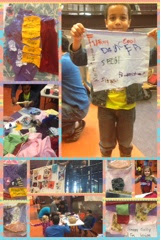
September was based on George Ella Lyon's poem "Where I'm From." The children wrote their own "Where I'm From" poems and created fabric flags representing "Where I'm From." We collected all of this amazing work into a LuLu book that can be found here. This book is in the community library and several copies will be in the school library when it opens in August 2017. It was a raging success in our opinion with about 30 kids attending, a lot of fun and some truly inspired writing and art.
October was based on the election. Again, raging success. Around 30+ kids creating poignant writing, art and film. Tons of fun. We participated in the NWP's Letters 2 the Next President Site. Students had the choice of simply writing a letter letting the next president of the United States know what issues where on their minds, making a short movie, or creating a piece of political art. But we only had two hours and that did not leave time for real discussion of what we were doing and planning. What we ended up with was a collection of beautiful pieces in support of Presidential Candidate Hillary Clinton, but very little about actual issues.
This could be seen as a fail, but I choose to see it as an opportunity and a learning experience. First, the opportunity. We spliced everything together into the short film below and sent it to the Clinton campaign. The children's voices were indeed heard on a national level, which was a out main point. Kids have things to say and deserve to me heard. The children used their powers of literacy and created things to act on the world. They learned about political art and the learned how to operate the computer program to make the movies.
This is all pretty exciting, but what are learning is even more exhilarating. In these makes where we want to dive into the complexities of literacy and really act on the world around us, we need more time. A two hour 1 and done activity is fun and engaging, and learning happens, but I want more. I want to really get into the culture of iteration, literacy, tinkering, reflection and social justice. We need more time.
So - Two new ideas. . .
1) Community Events that cover two months where kids can start things in Part 1 and then revise in Part II.
2) Summer Camp. We have big plans for that this summer. A grant is being written. I'll leave it at that
3) Out-of-School Time once the school opens. We will have TIME then. Everyday kind of time for big iterated projects. Oh I just can't WAIT.
Showing posts with label NWP. Show all posts
Showing posts with label NWP. Show all posts
Thursday, November 10, 2016

Friday, May 27, 2016
Renaissance West Community Events
For the past school year, our Writing Project site has been partnering with Discovery Place Inc, a local science museum, to offer out-of-school-time community events at a new Purpose Built Community in Charlotte, NC, the Renaissance West Community Initiative.
Man - that was a lot of links.
I'm the ethnographic researcher for this project. A k-8 public school is being built in the neighborhood and is scheduled to open in August 2017. The idea is to hold monthly community events around literacy and make in order to foster a community of learning before the school even opens. I have a lot to say and a ton of data to work through this summer, but I wanted to start with this video where the children of the community show us what learning is all about.
Man - that was a lot of links.
I'm the ethnographic researcher for this project. A k-8 public school is being built in the neighborhood and is scheduled to open in August 2017. The idea is to hold monthly community events around literacy and make in order to foster a community of learning before the school even opens. I have a lot to say and a ton of data to work through this summer, but I wanted to start with this video where the children of the community show us what learning is all about.
Thursday, February 5, 2015
Is it a "Make"?
I wrote earlier this week about a "make" I did with a group of high school students using literary terms to create stop-motion videos.
I've been wondering out loud for days - is this a "make" since I gave them the instructions to produce a stop-action video that exemplified their term? In my mind one of the things that makes a "make" is the freedom to get in there and mess with things to see what happens without a lot of instructions. I've been wondering if my attempts to make "make" "count" for school had gotten in the way of the play and tinkering I discovered this past summer.
As a group the UNCC Writing Project has identified a "make" as something that "invites students to make things with words, with natural and man-made materials, and with their ideas of how to make their worlds." (from Intersections Grant)
Check. Students worked with play dough and legos to represent their ideas using a stop action app.
Further "make" "gives students opportunities to play with, try out, or represent ideas through physically and digitally making things and then sharing drafts in progress" (from Intersections Grant)
Check. Students played with the play dough, legos and apps and shared their drafts in progress with each other and with our Google + community.
Finally, "make" "use[s] content specific to grade levels' course of study and are literacy rich, asking students and teachers to share, reflect, loop back, remake, revise, remix, and connect with others." (from Intersections Grant)
Check. Students used the literary terms specific to their course to do all of these things as they created their videos - several different iterations over the 40 minute period - and shared those videos with others. While they were working, I wished for a boom mic to drop down and record the rich and conversations they were having about not only the literary terms, but the materials they were working with and the process they were going through.
Below is a simple video with some of their reflections.
So while in the beginning I was feeling like this assignment was just sort of on the spectrum of make because it was "assignment-y" I'm feeling now after really breaking it down like it was a real and powerful making experience for the students and for me.
I've been wondering out loud for days - is this a "make" since I gave them the instructions to produce a stop-action video that exemplified their term? In my mind one of the things that makes a "make" is the freedom to get in there and mess with things to see what happens without a lot of instructions. I've been wondering if my attempts to make "make" "count" for school had gotten in the way of the play and tinkering I discovered this past summer.
As a group the UNCC Writing Project has identified a "make" as something that "invites students to make things with words, with natural and man-made materials, and with their ideas of how to make their worlds." (from Intersections Grant)
Check. Students worked with play dough and legos to represent their ideas using a stop action app.
Further "make" "gives students opportunities to play with, try out, or represent ideas through physically and digitally making things and then sharing drafts in progress" (from Intersections Grant)
Check. Students played with the play dough, legos and apps and shared their drafts in progress with each other and with our Google + community.
Finally, "make" "use[s] content specific to grade levels' course of study and are literacy rich, asking students and teachers to share, reflect, loop back, remake, revise, remix, and connect with others." (from Intersections Grant)
Check. Students used the literary terms specific to their course to do all of these things as they created their videos - several different iterations over the 40 minute period - and shared those videos with others. While they were working, I wished for a boom mic to drop down and record the rich and conversations they were having about not only the literary terms, but the materials they were working with and the process they were going through.
Below is a simple video with some of their reflections.
So while in the beginning I was feeling like this assignment was just sort of on the spectrum of make because it was "assignment-y" I'm feeling now after really breaking it down like it was a real and powerful making experience for the students and for me.
Saturday, June 21, 2014
Confessing Making
I've spent the past week working with the teachers from our Partnership Schools on an intense focus of Making STEAM. The maker movement has been alive and thriving in our group. Currently the daybook I'm drafting this post in is flashing red, blue and green through the pages as a result of a paper circuitry make using copper tape and LED's to remind me of my new found comfort with play.


You see, even though I've been messing around with make for the past year, I've had this nagging feeling somewhere way in the back of my head about its curricular connections. On Tuesday in Lacy's workshop I read a piece from Tinkering:Kids Learn by Making Stuff that really did a great job of connecting up the power of make for nontraditional students.
We work with a lot of "at-risk" kids, rough kids who are falling through the cracks of the system. We actually seek out these kids because we see that they are often quite successful at tinkering, using tools, making a project work, and adding new ideas. It is clear that often this success is new to them and that it builds confidence. This sort of confidence is solid-not the ephemeral sort that comes and goes with an authority figure's praise - for after a successful tinkering experience, there is no question of the student's capabilities.
This confidence, this lack of doubt about a student's capabilities is what's missing for so many of our school children who are shown daily that they aren't smart by the testing industry. In this context Make seems like not only a cool way of learning and connecting up curriculum in ways that grab student interests, but an essential way of teaching and learning if we mean develop student identities in each and every one of our students.
Sunday, March 30, 2014
Quilt Making at the Maker Faire- Where's the Science?
Yesterday the UNCC Writing Project held a Maker Faire. My make was story quilt blocks. We had tons of fabric from my mother and mother-in-law and the kids had a grand time writing 6 word memoirs and then making quilt blocks to represent them. There was tons of cutting of fabric and fabric glue involved. So what I'm wondering is where is the science in this make?
Sunday, August 5, 2012
On Planning
It's that time of year for me. I've been planning a week-long workshop centered around making the Common Core matter in the lives of students for 70 teachers about to start the 2012-2013 school year. Last week, I was in Chicago planning partnerships with 70 other National Writing Project consultants. In and among all of this, I've been planning for my freshman composition course this fall.
What strikes me about all of this planning (other than how much FUN it is) is that my plans would never be the same without the community of educators I have around me that are as hyped up about planning as I am.
And then I'm sad, and even angry, about how isolating teaching K-12 can be. We get shut up in our own buildings and classrooms. Any interaction with other teachers is often scripted by administrations in this era of "ridding ourselves of bad teachers." It's so rare for many teachers in many schools to have the time and space to plan, to do what teachers do, to come up with creative, awesome plans for their students that make the teacher jump out of her chair and do a little dance because they are just so excited about what comes next. (Okay, maybe I'm the only one who actually does that.)
Instead, teachers are forced to fill out forms in meetings to prove that they are "hitting" standards each day. Standards are certainly an important part of our planning, but something is very, very wrong when those standards suck the life and joy out of the planning process as they seem to do in many of our schools with the highest needs. In my experience, the teachers in "high needs" schools are some of the most creative and enthusiastic when it comes to meeting their students where they are and getting them to where they need to be, and yes, meeting standards. However, they have to do all of that off the clock and behind closed doors. And when they are "caught" doing it, they are labeled as "resistant" and "problematic," the same labels the students they teach carry with them.
And as a nation we continue to wonder where all of the "good" teachers have gone. It doesn't matter what standards we write and how great they are if we fail to recognize the professionalism, creativity and brilliance of our teachers.
What strikes me about all of this planning (other than how much FUN it is) is that my plans would never be the same without the community of educators I have around me that are as hyped up about planning as I am.
And then I'm sad, and even angry, about how isolating teaching K-12 can be. We get shut up in our own buildings and classrooms. Any interaction with other teachers is often scripted by administrations in this era of "ridding ourselves of bad teachers." It's so rare for many teachers in many schools to have the time and space to plan, to do what teachers do, to come up with creative, awesome plans for their students that make the teacher jump out of her chair and do a little dance because they are just so excited about what comes next. (Okay, maybe I'm the only one who actually does that.)
Instead, teachers are forced to fill out forms in meetings to prove that they are "hitting" standards each day. Standards are certainly an important part of our planning, but something is very, very wrong when those standards suck the life and joy out of the planning process as they seem to do in many of our schools with the highest needs. In my experience, the teachers in "high needs" schools are some of the most creative and enthusiastic when it comes to meeting their students where they are and getting them to where they need to be, and yes, meeting standards. However, they have to do all of that off the clock and behind closed doors. And when they are "caught" doing it, they are labeled as "resistant" and "problematic," the same labels the students they teach carry with them.
And as a nation we continue to wonder where all of the "good" teachers have gone. It doesn't matter what standards we write and how great they are if we fail to recognize the professionalism, creativity and brilliance of our teachers.
Saturday, July 21, 2012
Thursday, July 19, 2012
On the Closing of SI 2012
I've been participating in UNCCWP Summer Institues since 1999. In fact, I often mark years by the Summer Institutes, for example, thinking back when someone ask me when such and such happened to the year that X happened in SI. That may be a little weird, but I'm putting it out there because I'm trying to explain here how much this experience has meant and does mean to me.
There's just something powerful and amazing about a group of teachers voluntarily coming together for six hours everyday over the coures of weeks to think this hard about what happens in our classrooms. We almost lost SI in the spring of 2011. I still remember Lacy, Lil and I sitting in Lil's office, crying and cursing because the NWP budget had been cut. We'd already invited 18 amazing teachers and we didn't have the money now to run the program. We scrambled and rearranged and made it happen, but we didn't know about this year.
But SI 2012 DID happen. It's still happening right now, even though tomorrow is the last day. It happened in ways we've never done before. In ways we couldn't have imagined. And it is one powerful, amazing group of teachers. So, am I nostalgic tonight? You bet I am, and I'll not apologize for it. Because these people came together, I have a stack of blog posts and thinking and ideas and passion that will fuel me for the coming school year. I have a new groups of amazing colleagues that I honestly call friends because we have spend this time inquiring, puzzling, furrowing our brows and out loud laughing together. We have blogged and tweeted, which was especially important to me because I have not been able to share the physical space this past week.
This group has reminded me yet again what Writing Project means to me!
Thank you SI 2012! See ya'll at Amelie's tomorrow for open mic!
There's just something powerful and amazing about a group of teachers voluntarily coming together for six hours everyday over the coures of weeks to think this hard about what happens in our classrooms. We almost lost SI in the spring of 2011. I still remember Lacy, Lil and I sitting in Lil's office, crying and cursing because the NWP budget had been cut. We'd already invited 18 amazing teachers and we didn't have the money now to run the program. We scrambled and rearranged and made it happen, but we didn't know about this year.
But SI 2012 DID happen. It's still happening right now, even though tomorrow is the last day. It happened in ways we've never done before. In ways we couldn't have imagined. And it is one powerful, amazing group of teachers. So, am I nostalgic tonight? You bet I am, and I'll not apologize for it. Because these people came together, I have a stack of blog posts and thinking and ideas and passion that will fuel me for the coming school year. I have a new groups of amazing colleagues that I honestly call friends because we have spend this time inquiring, puzzling, furrowing our brows and out loud laughing together. We have blogged and tweeted, which was especially important to me because I have not been able to share the physical space this past week.
This group has reminded me yet again what Writing Project means to me!
Thank you SI 2012! See ya'll at Amelie's tomorrow for open mic!
Friday, March 25, 2011
What Writing Project Teachers Do
I met Samantha for the first time in the stack of Holocaust diaries. While the other papers are at least a page long and often longer, her diary is about a 4th of the page. There are reversed spellings all over the page, I can’t decipher a few of the words, and the graphite is dark and smudged with the effort of the person holding the pencil and transferring her thoughts onto the paper. If I’m honest, I know that this paper frightens me. It looks remarkably like something my kindergarten son would write. It is the kind of paper that people put into my hands and ask, “what do we DO with this.” It is difficult to get past the conventions to the writer’s thoughts. And yet, what is on the page, once deciphered is disturbing, even for a Holocaust diary. She writes of rape. The alarm bells go off. “What do we DO with this.”
I talk with her teacher. He tells me that she is an “EC” girl who “reads below grade level.” He tells me that she is “an angry girl” and lets me know that he feels that her “anger has come out in this writing.” He also lets me know that though he has been able to get her to “cut and paste” or copy words from a book onto paper to answer a question, this is “the first time that she has shared her thoughts on paper” and his face is awash with his pride for this big step she has taken, his concern for her, and what will happen if this writing is “published.” What do we DO with this?
I meet Samantha one-on-one. She knocks quietly on the door of the empty classroom I’m using to interview students and I double check my list to be sure I’ve asked for the right girl. She’s not who I was expecting. He hair is pulled back into a short pony tail, her soft, baby-face cheeks stretch into a sweet, shy smile. “I’m Samantha” she all but whispers. And then she meets my eyes. Soft, brown and wary. Very, very wary.
We begin to talk about her writing. Here voice is steady and strong. She is smart and articulate. She tells me how important she thinks it is that these pieces will be published in a movie. She wants people to know what happened during the holocaust and she recognizes to power in her own voice in telling that story.
She also tells me how she doesn’t really like school, how she used to get in trouble in elementary school, and how there is “too much drama in this school.” But then she says, “I used to be in a lot of drama before, but I got my stuff together now!” I cheer and she sits up straight, beaming and says, with a quite confidence “I’m proud of myself!”
But then I ask her about other writing and she tells me that she just doesn’t write on her own time, that she doesn't really like to write. I think the interview is over, but I ask, “is there anything else you’d like to tell me about writing.” She pauses, sizes me up and then tells me about a book she wrote in 2nd grade about a “really, really sad, bad time in [her] life” that she doesn’t “normally talk about much.” She tells me how hard it was to write, but then comes back to that theme she had at the beginning of the interview. We write so that others know what happened, so that it can help them. The power of her own voice and her own stories have made an impression on this young woman and she is empowered, compelled even, to put both out there. She leaves and I think “What do we DO with this?”
Two days later, I go to the classroom to snap some pictures for the movie I’m making to publish the dairies. I see Samantha again. The articulate, animated, shy smiling, powerful girl is gone. She sits as far back in the carefully arranged backless classroom as possible, slouched down in the chair, eyes on her desk. Her face and body language read “stay back” and “untouchable.” Her classmates raise their hands in response to questions, chattering and whispering with each other on their communal quest for the right answer. Samantha remains immobile, staring. Her teacher calls on her. She slowly raises her eyes, sighs and smacks her teeth, looks back down. He presses her to consult the book. She slowly raises her hand to it, slams it open and flips pages with a feigned boredom. He gently presses her, telling her she can do it, then moves to another student. I wonder, “what do we DO with this?”
* * *
I recently shared Samantha’s story in a National Writing Project conference. Her voice, rang through the room as we all sat, looking at her writing. “I’ve got my stuff together now. I’m proud of myself.” Afterwards, an audience member said, “This is the real work” pointing again to Samantha’s writing. “This is what Writing Projects teachers do.”
Writing Project teachers search out all the layers of students and their writing. They look beyond what is on the page and into the whole child, and into the socio-cultural history that child brings with her. They recognize growth and change before the numbers can show it, and they help students to do the same.
They also learn from their students. They know that they don’t have all of the answers. They answer the question, “What do we DO with this” with more questions for the student, for the student’s family and for other teachers. They share the stories of these students and they ask collegues what they see in them. It is this constant state of reflective inquiry and collegiality that makes up a "master teacher" and the UNC Charlotte Writing Project has made that space possible for me and for my thinking teaching colleagues.
Subscribe to:
Posts (Atom)