We are in our second year of Renaissance West Community Makes. We are really starting to build some trust in the community.
We learned last year that makes with few directions were the ones where kids really embraced the tenants of make as we see them - tinkering, iteration, creation. With that in mind, our first Community Make Events were thematic.
September was based on George Ella Lyon's poem "Where I'm From." The children wrote their own "Where I'm From" poems and created fabric flags representing "Where I'm From." We collected all of this amazing work into a LuLu book that can be found here. This book is in the community library and several copies will be in the school library when it opens in August 2017. It was a raging success in our opinion with about 30 kids attending, a lot of fun and some truly inspired writing and art.
October was based on the election. Again, raging success. Around 30+ kids creating poignant writing, art and film. Tons of fun. We participated in the NWP's Letters 2 the Next President Site. Students had the choice of simply writing a letter letting the next president of the United States know what issues where on their minds, making a short movie, or creating a piece of political art. But we only had two hours and that did not leave time for real discussion of what we were doing and planning. What we ended up with was a collection of beautiful pieces in support of Presidential Candidate Hillary Clinton, but very little about actual issues.
This could be seen as a fail, but I choose to see it as an opportunity and a learning experience. First, the opportunity. We spliced everything together into the short film below and sent it to the Clinton campaign. The children's voices were indeed heard on a national level, which was a out main point. Kids have things to say and deserve to me heard. The children used their powers of literacy and created things to act on the world. They learned about political art and the learned how to operate the computer program to make the movies.
This is all pretty exciting, but what are learning is even more exhilarating. In these makes where we want to dive into the complexities of literacy and really act on the world around us, we need more time. A two hour 1 and done activity is fun and engaging, and learning happens, but I want more. I want to really get into the culture of iteration, literacy, tinkering, reflection and social justice. We need more time.
So - Two new ideas. . .
1) Community Events that cover two months where kids can start things in Part 1 and then revise in Part II.
2) Summer Camp. We have big plans for that this summer. A grant is being written. I'll leave it at that
3) Out-of-School Time once the school opens. We will have TIME then. Everyday kind of time for big iterated projects. Oh I just can't WAIT.
Thursday, November 10, 2016

Tuesday, October 25, 2016
Tinkering and Traditional Learning
At this moment, I am working on a new book about make in the middle school classroom while my personal middle schooler sits beside me working on science.
One of the things I'm writing about is the idea of tinkering in the formal learning space of school and hacking the idea of traditional school.
The boy's assignment is about as traditional as you can get. He is to read the section in his Science text book and answer the questions at the end. Sigh.
However, he and I have been talking as he reads about what he's reading. The section is about diffraction, refraction and reflection of waves. Waving our hands around and drawing pictures, we've been playing with the ideas and trying them out. Tinkering. Trying, failing, making a mess with our drawings, and trying again. Someone walking into our workspace would see traditional school, but if that person were to observe for a moment, they would see authentic learning through trying out and trying on.
The key, I'm thinking, is the reflection on what we were doing. How learning was happening (and make no mistake, I was learning too as I am no expert on waves). How tinkering is learning and how that is a natural process that learners use.
Reading and answering questions is not authentic learning for sure, but tinkering with the information to figure it out and figure out the answers to the questions - the process that happens underneath that very traditional assignment is. So my question and what I want to keep thinking about - how do we value that tinkering? How do we pull it out into the light and make it THE thing that we are pointing to accessing rather than the answers to the questions?
One of the things I'm writing about is the idea of tinkering in the formal learning space of school and hacking the idea of traditional school.
The boy's assignment is about as traditional as you can get. He is to read the section in his Science text book and answer the questions at the end. Sigh.
However, he and I have been talking as he reads about what he's reading. The section is about diffraction, refraction and reflection of waves. Waving our hands around and drawing pictures, we've been playing with the ideas and trying them out. Tinkering. Trying, failing, making a mess with our drawings, and trying again. Someone walking into our workspace would see traditional school, but if that person were to observe for a moment, they would see authentic learning through trying out and trying on.
The key, I'm thinking, is the reflection on what we were doing. How learning was happening (and make no mistake, I was learning too as I am no expert on waves). How tinkering is learning and how that is a natural process that learners use.
Reading and answering questions is not authentic learning for sure, but tinkering with the information to figure it out and figure out the answers to the questions - the process that happens underneath that very traditional assignment is. So my question and what I want to keep thinking about - how do we value that tinkering? How do we pull it out into the light and make it THE thing that we are pointing to accessing rather than the answers to the questions?
Monday, June 20, 2016
Out-of-School Time at Renaissance West - Relationship Building and Trust
Out-of-School time offers and interesting conundrum that I had not expected. I should have expected it, but I didn't.
With school, people are compelled to send their children by law. However, out-of-school time is an option and requires intense relationship building and trust building to make it successful.
For the past year, the UNCC Writing Project and Discovery Place Inc. have been offering monthly out-of-school time community events at Renaissance West. I've talked about that some here.
However, the trick has been getting parents and children to actually attend the events. This is a brand new community and the residents don't know each other. They don't know us. And it's hard to separate us from all the people watching over them from the Charlotte Housing Authority. The first step is to build a relationship of trust. It is to let folks know that we are there to learn as much as we are to teach and the last thing we are there to do is to tell them how to be in the world.
Writing all of this has made me wonder what we ARE there to do. We have definite views about literacy and learning and the intersections between science and literacy. We are offering informal learning spaces. But we are also really working hard to keep what the residents of the community already know if front of us and use that to connect up the world of school with their lives. And that's the really hard part because we have to first earn trust before we can learn about these things.
In May, after 8 months of coming to the community, this little girl came flying through the door with her grandmother and said "I'm SO happy to see you here."

YES! A step in the right direction.
With school, people are compelled to send their children by law. However, out-of-school time is an option and requires intense relationship building and trust building to make it successful.
For the past year, the UNCC Writing Project and Discovery Place Inc. have been offering monthly out-of-school time community events at Renaissance West. I've talked about that some here.
However, the trick has been getting parents and children to actually attend the events. This is a brand new community and the residents don't know each other. They don't know us. And it's hard to separate us from all the people watching over them from the Charlotte Housing Authority. The first step is to build a relationship of trust. It is to let folks know that we are there to learn as much as we are to teach and the last thing we are there to do is to tell them how to be in the world.
Writing all of this has made me wonder what we ARE there to do. We have definite views about literacy and learning and the intersections between science and literacy. We are offering informal learning spaces. But we are also really working hard to keep what the residents of the community already know if front of us and use that to connect up the world of school with their lives. And that's the really hard part because we have to first earn trust before we can learn about these things.
In May, after 8 months of coming to the community, this little girl came flying through the door with her grandmother and said "I'm SO happy to see you here."

YES! A step in the right direction.
Wednesday, June 15, 2016
Engagement
One of the biggest questions in Urban Schools and student work there is the one of engagement. These students are often depicted as lethargic and uninterested in their education, in what's happening in the classroom, and the work they are assigned.
There are loads of reasons for this seeming disengagement, but as a teacher, I've always felt that the problem was with what I was offering, not with the students. If they were disengaged, it was because I wasn't bringing my A game to the classroom.
Today, I am sitting in the back of a classroom at Renaissance West where I am "leading" a camp based in oral histories. I put that in quotes because today, for the last two hours, I have been working away on my own writing while the students work on a documentary using the footage the obtained by interviewing the seniors in the neighborhood. At the one hour mark, I called for a break. They ignored me and kept working. They are still working. Talking together, googling to trouble-shoot, crafting their narrative, working in the music. They are learning about writing, composition, Movie Maker, computers and technology in general, and about the world. They are involved in social justice work and making sure their voices are heard.
These are not "special" students. These are not even "A" students. These are the same students who in the face of "getting ready for the test" appear lethargic and disinterested. Because this "work" is real and it matters. And THAT is what makes the difference.
There are loads of reasons for this seeming disengagement, but as a teacher, I've always felt that the problem was with what I was offering, not with the students. If they were disengaged, it was because I wasn't bringing my A game to the classroom.
Today, I am sitting in the back of a classroom at Renaissance West where I am "leading" a camp based in oral histories. I put that in quotes because today, for the last two hours, I have been working away on my own writing while the students work on a documentary using the footage the obtained by interviewing the seniors in the neighborhood. At the one hour mark, I called for a break. They ignored me and kept working. They are still working. Talking together, googling to trouble-shoot, crafting their narrative, working in the music. They are learning about writing, composition, Movie Maker, computers and technology in general, and about the world. They are involved in social justice work and making sure their voices are heard.
These are not "special" students. These are not even "A" students. These are the same students who in the face of "getting ready for the test" appear lethargic and disinterested. Because this "work" is real and it matters. And THAT is what makes the difference.
Friday, May 27, 2016
Renaissance West Community Events
For the past school year, our Writing Project site has been partnering with Discovery Place Inc, a local science museum, to offer out-of-school-time community events at a new Purpose Built Community in Charlotte, NC, the Renaissance West Community Initiative.
Man - that was a lot of links.
I'm the ethnographic researcher for this project. A k-8 public school is being built in the neighborhood and is scheduled to open in August 2017. The idea is to hold monthly community events around literacy and make in order to foster a community of learning before the school even opens. I have a lot to say and a ton of data to work through this summer, but I wanted to start with this video where the children of the community show us what learning is all about.
Man - that was a lot of links.
I'm the ethnographic researcher for this project. A k-8 public school is being built in the neighborhood and is scheduled to open in August 2017. The idea is to hold monthly community events around literacy and make in order to foster a community of learning before the school even opens. I have a lot to say and a ton of data to work through this summer, but I wanted to start with this video where the children of the community show us what learning is all about.
Saturday, August 1, 2015
Decomposing Revision
I compost.
Deep
pleasure in trash
In
eggshells and vegetable remains
Turning
into black gold.
Rich soil from our waste
Feeding my
garden
And my
soul.
I revise.
Deep
pleasure in refuse words
In messy
lines and phrases
Turning
into golden lines.
Rich language from the wreckage
Nourishing
my audience
And my
soul.
I relish decomposition
The process
of breaking down
The process
of fermentation
The process
of turning garbage into glory.
Friday, July 17, 2015
Twitter as a Tool for Reflective Teaching?
I was doing a session on playing with author blurbs as a way to study genre for our Writing Project Summer Institute. It was the 3rd time I'd done the workshop this summer and I was struggling to bring the enthusiasm. This is why I always had my classes reading different novels when I taught high school. Doing something the second time helps me work out the kinks, but by the third time I'm bored.
As I launched into my mini-lesson about genre as a site of action rather than a form to be filled out, the room was quiet. I continued on with my metaphor about writing into a genre being like going to a party - you have to know who the party is for and who is going to be there. The room was deadly quiet. People were typing on computers and scribbling notes, but few were making eye contact. Crap. I was boring the heck out of them. I finished up the mini-lesson and moved on to the activity. I picked up my phone to set a timer and found it exploding with tweets. Things like:
"Learning how to be recognized in the discourse and push the discourse with @birdawg"
"you can push the envelope as long as you know how to act at the party" birdawg on genre at this rockin' awesome SI session"
Well how about that! They were engaged in back-channeling about the session. And I'd hit the nail on the head. Not only that, but they were re-framing my words into their own, pointing to the things that were important to them in what I'd said.
I started thinking (again) about the use of Twitter in the classroom. What if students had the access to this during mini-lessons in school? What if they could point back to and re-frame what teachers were saying. It would certainly engage their active minds by having an outlet to communicate with others about what they were learning, but it would also show the teacher what is getting through and perhaps even what is causing confusion.
Thinking back on all of this now, I think this type of tweeting would need to be taught. When I've seen Twitter used in classrooms in the past it's been more about reporting out the agenda for the day . . . "we learned about worms today" These posts go a little beyond that, pointing to salient points in the lesson and lending them a sort of "A-men sister" to what I was saying. It's a little bit of ego stroking for me, for sure and I wouldn't want to turn it into a process of making me feel good about what I was doing in the classroom, but it sure was helpful when I had a break to see that what I had wanted to communicate had made it through and that I could build further on those concepts rather than re-teaching them.
If nothing else, I'm wanting to think more about this. I'm hoping I get a chance to play with this some during the school year.
As I launched into my mini-lesson about genre as a site of action rather than a form to be filled out, the room was quiet. I continued on with my metaphor about writing into a genre being like going to a party - you have to know who the party is for and who is going to be there. The room was deadly quiet. People were typing on computers and scribbling notes, but few were making eye contact. Crap. I was boring the heck out of them. I finished up the mini-lesson and moved on to the activity. I picked up my phone to set a timer and found it exploding with tweets. Things like:
"Learning how to be recognized in the discourse and push the discourse with @birdawg"
"you can push the envelope as long as you know how to act at the party" birdawg on genre at this rockin' awesome SI session"
Well how about that! They were engaged in back-channeling about the session. And I'd hit the nail on the head. Not only that, but they were re-framing my words into their own, pointing to the things that were important to them in what I'd said.
I started thinking (again) about the use of Twitter in the classroom. What if students had the access to this during mini-lessons in school? What if they could point back to and re-frame what teachers were saying. It would certainly engage their active minds by having an outlet to communicate with others about what they were learning, but it would also show the teacher what is getting through and perhaps even what is causing confusion.
Thinking back on all of this now, I think this type of tweeting would need to be taught. When I've seen Twitter used in classrooms in the past it's been more about reporting out the agenda for the day . . . "we learned about worms today" These posts go a little beyond that, pointing to salient points in the lesson and lending them a sort of "A-men sister" to what I was saying. It's a little bit of ego stroking for me, for sure and I wouldn't want to turn it into a process of making me feel good about what I was doing in the classroom, but it sure was helpful when I had a break to see that what I had wanted to communicate had made it through and that I could build further on those concepts rather than re-teaching them.
If nothing else, I'm wanting to think more about this. I'm hoping I get a chance to play with this some during the school year.
Wednesday, July 1, 2015
The Yogi Writer/ Maker - a Revision to Reclaim my Identity
Running and Writing.
I suffer an identity crisis every time I read this piece. It is the opening of my first book and people who have read it come and tell me how meaningful the analogy is to them - and that always follows with the dreaded question - "So how's the running going?"
The truth is, I don't run anymore. So then I'm compelled to tell the story of how I blew out my hip on a run when I tripped over the dog and now hot yoga is my jam. I even published a Digital IS resource about this identity crisis.
It occurs to me now, five years into yoga and nine years after the book was published that there is an analogy to be found in yoga and writing AND in making and writing. It's all in the idea of practice. Yoga is a practice. There is no race or competition to train for. You simply show up each day and practice your craft. You listen carefully to your body.
Writing and Making - composing if you will - is a lot like that. You show up each day and your practice your craft. You listen to what your soul is telling you to create. You speak the words that are there - composing carefully.
Sometimes you fly in your yoga practice, nailing each pose with a strong flexible body. Somedays you are stiff and wobbly and your side crow crashes into a face plant. On those days you have to revise your practice, to reiterate it. You have to listen closely to your body and let it tell you what it is capable of this day. You have to weed out the distractions that are making you wobbly, you have to find your drishti. But most of all, you continue to practice in the way your body will allow that day.
Sometimes your words or make fly together, speaking out to the world about ideas of importance. Carefully crafted statements of social justice fly onto the page or into the make. Somedays, nothing works. The glue isn't right, the pieces fall apart, the words won't come. On those days you have to focus on revision and reiteration. You have to listen closely to what your soul is telling you and get one word down, one piece put together. You have to try it out and see if it works and if it doesn't, you have to try again. You have to silence the distracting voices that tell you that you have nothing to say. But most of all, you continue to practice your craft in the way that your mind will allow that day.
The biggest lesson for me as I've grown from the running analogy to the yoga analogy is a spirit of playfulness. When I read that running piece I am struck by the hard work, the slogging through pain. Yoga is playful and so should writing and making be. It's a choice, approaching with this spirit of play. Making a mess and seeing what will happen is the heart and soul of writing and making. And that sense of play is far more encouraging to me as a writer and a maker than the drudgery of trying to craft perfect words or compel myself up a monster hill.
I suffer an identity crisis every time I read this piece. It is the opening of my first book and people who have read it come and tell me how meaningful the analogy is to them - and that always follows with the dreaded question - "So how's the running going?"
The truth is, I don't run anymore. So then I'm compelled to tell the story of how I blew out my hip on a run when I tripped over the dog and now hot yoga is my jam. I even published a Digital IS resource about this identity crisis.
It occurs to me now, five years into yoga and nine years after the book was published that there is an analogy to be found in yoga and writing AND in making and writing. It's all in the idea of practice. Yoga is a practice. There is no race or competition to train for. You simply show up each day and practice your craft. You listen carefully to your body.
Writing and Making - composing if you will - is a lot like that. You show up each day and your practice your craft. You listen to what your soul is telling you to create. You speak the words that are there - composing carefully.
Sometimes you fly in your yoga practice, nailing each pose with a strong flexible body. Somedays you are stiff and wobbly and your side crow crashes into a face plant. On those days you have to revise your practice, to reiterate it. You have to listen closely to your body and let it tell you what it is capable of this day. You have to weed out the distractions that are making you wobbly, you have to find your drishti. But most of all, you continue to practice in the way your body will allow that day.
Sometimes your words or make fly together, speaking out to the world about ideas of importance. Carefully crafted statements of social justice fly onto the page or into the make. Somedays, nothing works. The glue isn't right, the pieces fall apart, the words won't come. On those days you have to focus on revision and reiteration. You have to listen closely to what your soul is telling you and get one word down, one piece put together. You have to try it out and see if it works and if it doesn't, you have to try again. You have to silence the distracting voices that tell you that you have nothing to say. But most of all, you continue to practice your craft in the way that your mind will allow that day.
The biggest lesson for me as I've grown from the running analogy to the yoga analogy is a spirit of playfulness. When I read that running piece I am struck by the hard work, the slogging through pain. Yoga is playful and so should writing and making be. It's a choice, approaching with this spirit of play. Making a mess and seeing what will happen is the heart and soul of writing and making. And that sense of play is far more encouraging to me as a writer and a maker than the drudgery of trying to craft perfect words or compel myself up a monster hill.
Friday, March 13, 2015
Notice & Note
Written in response to "What is the Role of Talk" in Beers and Probst's Notice & Note: Strategies for Close Reading
Engaged
Co-constructors constructing knowledge
Questions - real questions
That probe and problematize
Analyzing
Synthesizing
Evaluating
Applying
Speculating
Inferring
Confirming
Talk that matters
Voices that matter
Learning that matters
Thursday, February 5, 2015
Is it a "Make"?
I wrote earlier this week about a "make" I did with a group of high school students using literary terms to create stop-motion videos.
I've been wondering out loud for days - is this a "make" since I gave them the instructions to produce a stop-action video that exemplified their term? In my mind one of the things that makes a "make" is the freedom to get in there and mess with things to see what happens without a lot of instructions. I've been wondering if my attempts to make "make" "count" for school had gotten in the way of the play and tinkering I discovered this past summer.
As a group the UNCC Writing Project has identified a "make" as something that "invites students to make things with words, with natural and man-made materials, and with their ideas of how to make their worlds." (from Intersections Grant)
Check. Students worked with play dough and legos to represent their ideas using a stop action app.
Further "make" "gives students opportunities to play with, try out, or represent ideas through physically and digitally making things and then sharing drafts in progress" (from Intersections Grant)
Check. Students played with the play dough, legos and apps and shared their drafts in progress with each other and with our Google + community.
Finally, "make" "use[s] content specific to grade levels' course of study and are literacy rich, asking students and teachers to share, reflect, loop back, remake, revise, remix, and connect with others." (from Intersections Grant)
Check. Students used the literary terms specific to their course to do all of these things as they created their videos - several different iterations over the 40 minute period - and shared those videos with others. While they were working, I wished for a boom mic to drop down and record the rich and conversations they were having about not only the literary terms, but the materials they were working with and the process they were going through.
Below is a simple video with some of their reflections.
So while in the beginning I was feeling like this assignment was just sort of on the spectrum of make because it was "assignment-y" I'm feeling now after really breaking it down like it was a real and powerful making experience for the students and for me.
I've been wondering out loud for days - is this a "make" since I gave them the instructions to produce a stop-action video that exemplified their term? In my mind one of the things that makes a "make" is the freedom to get in there and mess with things to see what happens without a lot of instructions. I've been wondering if my attempts to make "make" "count" for school had gotten in the way of the play and tinkering I discovered this past summer.
As a group the UNCC Writing Project has identified a "make" as something that "invites students to make things with words, with natural and man-made materials, and with their ideas of how to make their worlds." (from Intersections Grant)
Check. Students worked with play dough and legos to represent their ideas using a stop action app.
Further "make" "gives students opportunities to play with, try out, or represent ideas through physically and digitally making things and then sharing drafts in progress" (from Intersections Grant)
Check. Students played with the play dough, legos and apps and shared their drafts in progress with each other and with our Google + community.
Finally, "make" "use[s] content specific to grade levels' course of study and are literacy rich, asking students and teachers to share, reflect, loop back, remake, revise, remix, and connect with others." (from Intersections Grant)
Check. Students used the literary terms specific to their course to do all of these things as they created their videos - several different iterations over the 40 minute period - and shared those videos with others. While they were working, I wished for a boom mic to drop down and record the rich and conversations they were having about not only the literary terms, but the materials they were working with and the process they were going through.
Below is a simple video with some of their reflections.
So while in the beginning I was feeling like this assignment was just sort of on the spectrum of make because it was "assignment-y" I'm feeling now after really breaking it down like it was a real and powerful making experience for the students and for me.
Saturday, January 31, 2015
Making Our Words
Looking at a stack of literary terms a teacher wanted her students to learn and thinking about our Educator Innovator Project along with some cool stuff a colleague of mine, Steve Fulton, was doing with stop action video I thought, “why not make stop action videos with the literary terms?
I've written here about my thinking on making, its importance, and curricular connections. Since that posting, I've gotten a lot more comfortable with "make."
I've written here about my thinking on making, its importance, and curricular connections. Since that posting, I've gotten a lot more comfortable with "make."
Our Educator Innovator grant is focused on the concept of “make” and its connections to the ELA classroom. In our minds, our students will become Hacktivists, hacking into materials and creating products that act on the world for social justice in some way. At its core English Language Arts is about acting on the world. Too often students see the course as reading literature that is completely disconnected from themselves and answering questions about it, or perhaps writing and essay about it. They do not see the literature as examples of ways authors are acting on the world around them and they certainly don’t see their own writing (and making for us) as the literature of the classroom. The concept of Hacktivism gives us a chance to make the acting on the world front and center in our classrooms.
But, as I planned the lesson for the stop action literary terms, I was struck by all that I was asking the students to do in about 40 minutes. I was asking them to learn the stop action app (We used Lego Movie) choose materials from boxes of legos and play dough, define complex literary terms and then find ways to represent them in a stop motion video. This seemed a bit overwhelming, but I really felt strongly about exposing them to the idea of Hacktivism, so I offered bonus points (always a good incentive) for anyone who could work in the Hacktivist angle. What surprised me was the way in which the students lit up at the notion of Hacktivism. Granted, this could have been because they were seniors and they have to have some sort of service angle in their senior exit project, but many of the students simply seemed excited about having an avenue to act on their worlds.
One group of students created the following video about the term deus ex machina. In the video, not only do they resolve the conflict with an improbable event, (the moon falls from the sky and crushes the policeman) but they speak out against prejudice against non-traditional relationships through the interspecies relationship they represent in the video.
We posted all of the videos up to a shared private Google + site where the students could view and comment on one another's work. The videos became the literature of the class and one of the avenues by which the students could see the literary devices in action. They were also able to see one another acting on the world through the videos and comment on that aspect of the work.
For me, all of this hacking, making and learning comes back full circle to the notion of author's purpose and why the concept is so key to what we do in ELA classrooms - making our words.
Saturday, June 21, 2014
Confessing Making
I've spent the past week working with the teachers from our Partnership Schools on an intense focus of Making STEAM. The maker movement has been alive and thriving in our group. Currently the daybook I'm drafting this post in is flashing red, blue and green through the pages as a result of a paper circuitry make using copper tape and LED's to remind me of my new found comfort with play.


You see, even though I've been messing around with make for the past year, I've had this nagging feeling somewhere way in the back of my head about its curricular connections. On Tuesday in Lacy's workshop I read a piece from Tinkering:Kids Learn by Making Stuff that really did a great job of connecting up the power of make for nontraditional students.
We work with a lot of "at-risk" kids, rough kids who are falling through the cracks of the system. We actually seek out these kids because we see that they are often quite successful at tinkering, using tools, making a project work, and adding new ideas. It is clear that often this success is new to them and that it builds confidence. This sort of confidence is solid-not the ephemeral sort that comes and goes with an authority figure's praise - for after a successful tinkering experience, there is no question of the student's capabilities.
This confidence, this lack of doubt about a student's capabilities is what's missing for so many of our school children who are shown daily that they aren't smart by the testing industry. In this context Make seems like not only a cool way of learning and connecting up curriculum in ways that grab student interests, but an essential way of teaching and learning if we mean develop student identities in each and every one of our students.
Wednesday, April 2, 2014
More on the Rhetoric of Help
My husband is reading Lights out in Wonderland by DBS Pierre and ran across this quote:
"The need of this assortment of new-age ano-extremists to patronize, wield authority, and lord false compassion over others is a more breathtaking and sinister disturbance of character than anything I could aspire to.
This has me thinking again about the rhetoric of help. This quote gets at what is disturbing to me in the question "who gets to help and who has to be helped." This idea of swooping in to "fix" people in poverty and then lording over them how much better we are than them as a "breathtaking disturbance of character." I'm going to be thinking about this one for a while.
Sunday, March 30, 2014
Quilt Making at the Maker Faire- Where's the Science?
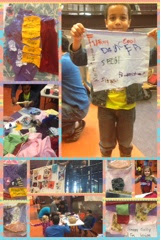
Yesterday the UNCC Writing Project held a Maker Faire. My make was story quilt blocks. We had tons of fabric from my mother and mother-in-law and the kids had a grand time writing 6 word memoirs and then making quilt blocks to represent them. There was tons of cutting of fabric and fabric glue involved. So what I'm wondering is where is the science in this make?
Tuesday, February 25, 2014
Thinking About 8th Grade and Class Size.
I mentioned that I was going to be working some in an 8th grade classroom. I did that last week and the class has been on my mind ever since.
There are 32 children in the class and they all really want to learn. The trouble is that that it feels like they ALL need individual attention. So you give directions, and then you walk around the classroom giving the directions again individually while they wait for you to get to them and get into mischief.
Thirty-two 8th graders in the same classroom, not to mention the 32 neediest kids in the school in the same classroom is a systemic issue and not one that I have a magic wand to solve. Ms. K and I have decided that the thing to do is to split the class in half for drafting of their research papers so that we can give them some more individual attention. It's a good solution but not a viable one for the real world. I'm there volunteering. I have 10 years of classroom experience under my belt along with a PhD in Urban Literacy. She has almost 20 years of experience, a master's degree and is a highly qualified, creative teacher with only this one class to teach. This classroom is my wheel house. And it's still very, very hard teaching because of the sheer number of students in the class that desperately need individual attention. There are teachers all over the state - the country - with multiple classes of students in just this same situation with no highly trained volunteer to help out.
So I'm problematized about this article I want to write. We are managing to engage the students with some real world writing and I do believe that the pieces that come out of this work will be notable. But it will take BOTH of us to accomplish this and that's just not something that's readily replicable. In my head this is becoming about the dire need for smaller class size.
There are 32 children in the class and they all really want to learn. The trouble is that that it feels like they ALL need individual attention. So you give directions, and then you walk around the classroom giving the directions again individually while they wait for you to get to them and get into mischief.
Thirty-two 8th graders in the same classroom, not to mention the 32 neediest kids in the school in the same classroom is a systemic issue and not one that I have a magic wand to solve. Ms. K and I have decided that the thing to do is to split the class in half for drafting of their research papers so that we can give them some more individual attention. It's a good solution but not a viable one for the real world. I'm there volunteering. I have 10 years of classroom experience under my belt along with a PhD in Urban Literacy. She has almost 20 years of experience, a master's degree and is a highly qualified, creative teacher with only this one class to teach. This classroom is my wheel house. And it's still very, very hard teaching because of the sheer number of students in the class that desperately need individual attention. There are teachers all over the state - the country - with multiple classes of students in just this same situation with no highly trained volunteer to help out.
So I'm problematized about this article I want to write. We are managing to engage the students with some real world writing and I do believe that the pieces that come out of this work will be notable. But it will take BOTH of us to accomplish this and that's just not something that's readily replicable. In my head this is becoming about the dire need for smaller class size.
Saturday, February 22, 2014
Making at Discovery Place

Our Writing Project is really embracing the Maker Movement. One of our major projects is "Making STEAM" a partnership between some K-12 schools and Discovery Place - a local science museum. A lot of the time I feel like I'm still trying to figure out what "making" is, but this field trip with some 8th graders from Kannapolis really helped move my thinking forward. There were spaces all over the museum where the kids could "make." Legos, blocks, duct tape, tin foil and crystalizing paint. The students just dove in and created all sorts of things. To me, this is the heart of making - experimenting with materials without too many instructions as to what to do with them. The kids were learning all sorts of things about that materials and structures as they created. Physics, Chemistry, Art - it was all in there. Amazing and humbling to watch.
And they are making major connections on our Google + Community. They took tons of pictures and notes in their daybooks and came back to school to "make" picture collages to post their reflections. It's amazing to see that they really do "get" "maker."
Saturday, February 8, 2014
Inklings of an Article
I have an article in my head that I want to write with a dear friend of mine who happens to also be an awesome teacher.
In my mind it opens like this. . .
"They were and unruly bunch, and with good reason. They'd been bounced around from teacher to teacher all semester before they finally found themselves in the steady care of Mrs. K. It's not surprising that it took some convincing for them to believe that she was there to stay and meant to teach them whether they liked it or not."
In my mind this is about engaging reluctant writers, but I want to tread carefully. This is not a teacher hero narrative like Freedom Writers or Dangerous Minds. This is about listening for the critique the resistant, reluctant student has on the system of education and capitalizing on that for learning. That's the challenge of this piece.
I should really do something with these wonderings about help here and here as well. Maybe all of it will work together somehow some way? Hmmm brow crinkles.
In my mind it opens like this. . .
"They were and unruly bunch, and with good reason. They'd been bounced around from teacher to teacher all semester before they finally found themselves in the steady care of Mrs. K. It's not surprising that it took some convincing for them to believe that she was there to stay and meant to teach them whether they liked it or not."
In my mind this is about engaging reluctant writers, but I want to tread carefully. This is not a teacher hero narrative like Freedom Writers or Dangerous Minds. This is about listening for the critique the resistant, reluctant student has on the system of education and capitalizing on that for learning. That's the challenge of this piece.
I should really do something with these wonderings about help here and here as well. Maybe all of it will work together somehow some way? Hmmm brow crinkles.
Wednesday, January 29, 2014
Bakhtin and Eagles
I found this in the drafts of my personal blog from 2008. It's speaking to me today about writers.
Last night I was lying in bed with the Braddock Essays freshly read on the heels of Bakhtin and Vygotsky at the end of a semester of reading in Rhetorical Theory. As I closed my eyes, I knew that today was the day to park myself in my chair and write/ wrestle with it all. And as I filtered through the ideas and theories streaming through my semi-conscious mind and gently probing for ways into the writing, for connections, for new ideas, I had the sudden image of myself hovering somewhat precariously on the edges of balance and strength in eagle pose.
The eagle is a tough pose for me. I consider myself a pretty strong person with a new found balance that I’ve cultivated over the past two years. Eagle has reminded me that one does not attack a yoga pose the way one attacks a hill sprint. You can’t gut out balance. The eagle must be approached with calm, peace, and respect. The scattered, racing mind will bring distain from the wise and regal posture. One must study the intention of the pose in her mind, think about arms, legs, core and what those muscles should be engaging without actually thinking of one muscle over the other. And then, she must totally relax, focus on a tiny dot of consciousness and hold her mind there, calm, assertive and at peace. The raw determination, pounding music, and thoughts of conquest and brute strength that propel a girl up a monster hill at top speed, beating the scattered mind into a state of exhausted submission are useless here. This is a new realm requiring new habits of mind and body, much like wrestling with theory.
My first real success with writing, and the piece that I am still most proud of, began with a metaphor of running and writing. At the time I was writing the piece (and running 4-7 miles a day) I felt that I had reached my pinnacle/ potential as writer, a teacher of writing. And then, a couple of years later, I found something new. I discovered that the writing that is most appealing to me and to my students is a hybrid of forms and genres. But as I began to attempt to write about it, the words, thoughts, ideas simply wouldn’t gel. “There is nothing NEW here.” I kept saying. “Multi-genre is not what I’m writing about.I didn’t even know that term when I started experimenting with this stuff. It’s the lyric essays and how they get kids to think that’s interesting.”
But Why? How? What?
And so began the process over the past year that had me hovering carefully and precariously in that calm assertive pose in my mind last night. But it is precarious because it is a calm that could shatter at any second if I listen to the voices in my head. The voices incidently, that so many of my students hear each time they sit down to compose school writing. And the voices that I hope to help them engage and transform.
What I’ve found and what I want to explore here is what happens when we respect the language practices and ways of knowing that our students bring to us as legitimate language practices that are useful and important to learning. The NEW ideas about language and literacy that can come from the bumping together of the institution along with all of the diverse things our students bring – from “playing” in the Vygotskian sense of the word with in the figured world of school and the improvisation that comes from that when “school” writing/ language meets “home” writing/ language.
Saturday, January 18, 2014
Tinkering with Failure
There is a poem, “Fire” by Judy Brown about space.
“Too much of a good thing” she says
“too many logs, packed in too tight”
will put out the fire.
This has me thinking of the space to fail.
But maybe failure is not what I mean.
Maybe I mean the space to tinker
to try out.
Success is a good thing and
I want my own children and my students
and myself to have it.
But at what cost?
When success is all that’s allowed
it becomes piled on
like too many logs
snuffing out the flames.Saturday, January 11, 2014
Read to Achieve
There are reports that prisons use third grade reading scores to predict how many beds they will need. While this little factoid is not true, "there is a connection between literacy rates, high school dropout rates, and crime."
Hence the Read to Achieve Law passed by North Carolina in 2012.
The law essentially states that 3rd graders must pass the End of Grade Reading test (EOG) in order to move on to 4th grade.
Students get two chances to pass the EOG test at the end of the year. If they fail twice, parents can request that the student take the "Read to Achieve" test. They also get the chance to build a portfolio comprised of 36 tests developed by the NC Department of Public instruction around 12 reading standards, Reading 3D reports and a Personal Education Plan if the student has one. Students have 8 chances to pass 3 tests on each of the 12 standards. If they do not pass a standard, they cannot complete the portfolio.
If students pass those tests, they can be promoted. If all of that fails, they are required to go to summer school, or summer "camp" as our district is calling it, where they will take the "Read to Achieve" test again at the end and continue to work on passing the portfolio. If they STILL fail the portfolio or the test, they go to a 4th grade classroom with a 3rd grade retention marker on their file. The student will learn 4th grade material and be given intensive help with reading. They will take the test again in November. If the student still doesn't pass, they continue to receive help and take the 4th grade EOG test at the end of the year. Whether or not they pass that test, the school can then decide whether to retain the student or send them on to 5th grade.
Obviously students have many opportunities to pass the test and many measures are being put in place to help all students pass and learn to read. That's a good thing.
The problem I have is that the ability to read is being solely equated with passing multiple choice tests. There is so much more to reading than that. There is nothing here about love of story and love of books and information. There is nothing here about reading for the sheer joy of learning something new. Much more emphasis is being put on teaching students to pass a test than actually teaching them to read and be life long readers. While I think having a portfolio is a huge step in the right direction in this process, I'd like to see more project-based work that allowed students to show what they know at an individual level. I want to see how students perform when they are engaged with texts that are interesting and important to them. All of the testing equates students to widgets on the factory assembly line. A project based portfolio would be more expensive and time consuming to assess, but don't our students deserve that time and investment?
Hence the Read to Achieve Law passed by North Carolina in 2012.
The law essentially states that 3rd graders must pass the End of Grade Reading test (EOG) in order to move on to 4th grade.
Students get two chances to pass the EOG test at the end of the year. If they fail twice, parents can request that the student take the "Read to Achieve" test. They also get the chance to build a portfolio comprised of 36 tests developed by the NC Department of Public instruction around 12 reading standards, Reading 3D reports and a Personal Education Plan if the student has one. Students have 8 chances to pass 3 tests on each of the 12 standards. If they do not pass a standard, they cannot complete the portfolio.
If students pass those tests, they can be promoted. If all of that fails, they are required to go to summer school, or summer "camp" as our district is calling it, where they will take the "Read to Achieve" test again at the end and continue to work on passing the portfolio. If they STILL fail the portfolio or the test, they go to a 4th grade classroom with a 3rd grade retention marker on their file. The student will learn 4th grade material and be given intensive help with reading. They will take the test again in November. If the student still doesn't pass, they continue to receive help and take the 4th grade EOG test at the end of the year. Whether or not they pass that test, the school can then decide whether to retain the student or send them on to 5th grade.
Obviously students have many opportunities to pass the test and many measures are being put in place to help all students pass and learn to read. That's a good thing.
The problem I have is that the ability to read is being solely equated with passing multiple choice tests. There is so much more to reading than that. There is nothing here about love of story and love of books and information. There is nothing here about reading for the sheer joy of learning something new. Much more emphasis is being put on teaching students to pass a test than actually teaching them to read and be life long readers. While I think having a portfolio is a huge step in the right direction in this process, I'd like to see more project-based work that allowed students to show what they know at an individual level. I want to see how students perform when they are engaged with texts that are interesting and important to them. All of the testing equates students to widgets on the factory assembly line. A project based portfolio would be more expensive and time consuming to assess, but don't our students deserve that time and investment?
Subscribe to:
Posts (Atom)